
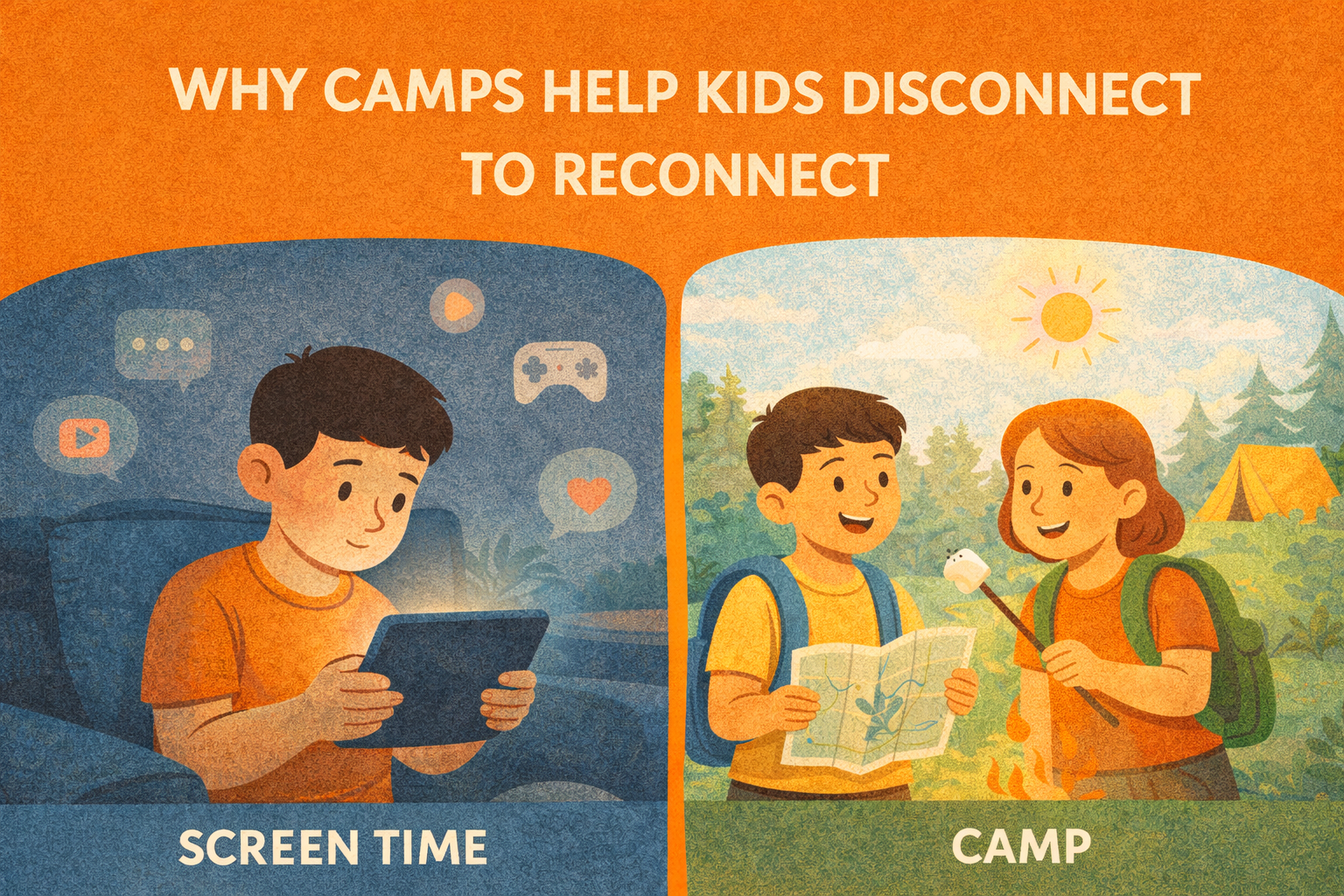
Introduction – When Being “Connected” Means Feeling Disconnected
It usually starts quietly.
A child scrolling endlessly on a tablet. A teenager glued to their phone during dinner. A family holiday where everyone is technically together—but mentally elsewhere.
One parent once told me, “My child talks to friends all day online, but somehow feels lonelier than ever.”
In today’s hyper-connected world, children are more digitally connected than any generation before them. Yet many parents are noticing something concerning: constant screen time is crowding out real connection—with nature, with peers, and even with themselves.
This is where camps step in, offering something increasingly rare and valuable: space to disconnect in order to truly reconnect.
In this article, we’ll explore why camps help kids disconnect to reconnect, how stepping away from screens supports emotional and social well-being, and why these experiences can be transformative for children of all ages.
The Reality of Screen-Centered Childhoods
Screens are everywhere—and for good reason. Technology supports learning, creativity, and communication. But without balance, it can also create challenges.
Many children today experience:
Reduced face-to-face interaction
Shortened attention spans
Difficulty managing boredom
Increased anxiety or irritability
Limited outdoor play
Parents aren’t wrong to worry. The goal isn’t to eliminate technology—but to create healthy distance so children can reconnect with what truly matters.
What Does It Mean to “Disconnect to Reconnect”?
Disconnecting doesn’t mean isolation. It means stepping away from constant digital input to make space for:
Self-awareness
Real-world relationships
Creativity
Emotional regulation
Presence in the moment
Camps provide structured environments where this happens naturally, without forcing rules or punishment.
Why Camps Are Ideal Places to Unplug
Camps are intentionally designed around human connection.
At camp:
Screens are limited or removed
Activities are hands-on
Interaction is face-to-face
Nature often plays a central role
Time feels slower and more intentional
Children don’t just lose screens—they gain experiences.
Parents across Asia explore screen-light and screen-free camp environments using platforms like Camp Finder Asia:
👉 https://campfinderasia.com/
1. Camps Replace Screen Time with Real Experiences
At home, boredom often leads to screens. At camp, boredom leads to exploration.
Active Engagement Instead of Passive Consumption
Instead of watching others do things, kids at camp:
Build
Create
Move
Collaborate
Explore
This shift from passive to active engagement helps children feel more alive and involved.
2. Reconnecting with Nature Grounds Children Emotionally
Nature has a calming effect that screens can’t replicate.
At camp, children reconnect with:
Trees, water, and open spaces
Natural rhythms of day and night
Physical sensations and movement
Studies consistently show that time outdoors reduces stress and improves mood. Camps bring this benefit into children’s everyday experience.
3. Face-to-Face Friendships Grow Stronger Without Screens
Digital communication is fast—but it often lacks depth.
Real Conversations, Real Bonds
Without screens, children:
Talk more
Listen better
Read facial expressions
Learn empathy
Camp friendships often feel deeper because they’re built on shared moments, challenges, and laughter—not just messages and emojis.
4. Kids Rediscover Who They Are Without Online Pressure
Online spaces can shape identity through likes, comparisons, and constant feedback.
At camp:
Children aren’t measured by followers
There’s no need to “perform”
Self-expression feels safer
Many kids discover confidence and authenticity when they’re no longer trying to keep up with online expectations.
5. Attention Spans Improve When Screens Step Back
Constant digital stimulation can make it harder for children to focus.
Camps support attention by:
Encouraging sustained activities
Allowing natural boredom (which sparks creativity)
Slowing the pace of daily life
Over time, children become more patient, focused, and present.
6. Emotional Regulation Gets Easier Without Constant Input
Screens provide constant distraction. When they’re gone, emotions surface—and that’s a good thing.
At camp, children learn to:
Sit with feelings
Express emotions verbally
Manage frustration
Seek support appropriately
This emotional awareness is essential for long-term well-being.
7. Camps Encourage Meaningful Social Skills
Without devices to hide behind, kids practice real-world social skills.
They learn how to:
Start conversations
Resolve conflicts
Compromise
Apologize and forgive
These moments build confidence and emotional intelligence in ways screens cannot.
8. Creativity Flourishes in Screen-Free Spaces
Screens often dictate what kids see and think.
Camps invite creativity by offering:
Open-ended activities
Art, storytelling, and role-play
Problem-solving challenges
When imagination leads, children feel empowered and inspired.
9. Parents Often Notice Changes After Camp
Many parents report noticeable differences after camp.
Children return:
More communicative
Calmer and more patient
More engaged with family
Less dependent on screens
These changes often surprise families—in the best way.
Day Camps vs Overnight Camps: Different Paths to Reconnection
Both types of camps support healthy disconnection.
Day Camps
Great for younger children
Offer daily screen breaks
Help establish balanced routines
Overnight Camps
Create deeper digital detox
Strengthen independence
Deepen peer bonds
Parents can explore both options on Camp Finder Asia:
👉 https://campfinderasia.com/
How Camps Teach Balance, Not Avoidance
Camps don’t teach children to fear technology. They teach balance.
By experiencing life without constant screens, children learn:
Technology is a tool, not a crutch
Offline experiences are rewarding
Connection doesn’t require devices
This mindset helps children make healthier choices long after camp ends.
How Camp Finder Asia Helps Families Find the Right Fit
Not all camps approach screen use the same way.
Camp Finder Asia helps parents:
Explore camps across Asia
Understand camp philosophies
Choose environments aligned with family values
Find programs that support healthy balance
Explore camp options here:
👉 https://campfinderasia.com/
A Real-Life Story – “I Forgot About My Phone”
When Daniel attended his first camp, his parents worried. He rarely went an hour without his phone.
On the second day of camp, he stopped asking for it. By the end of the week, he said something unexpected:
“I forgot about my phone. I was too busy.”
Daniel returned home happier, more engaged, and more confident. His parents realized the phone wasn’t the problem—the lack of alternative connection was.
Addressing Common Parent Concerns
“What if my child feels anxious without their device?”
Initial discomfort is normal. Camps support children gently, helping them adjust and feel safe.
“Is disconnecting realistic in today’s world?”
Yes—when done temporarily and intentionally. Camps model healthy boundaries.
“Will my child fall behind socially?”
In fact, children often develop stronger social skills through face-to-face interaction.
FAQs About Camps and Digital Disconnection
1. Are camps completely screen-free?
Some are, while others limit use. It depends on the camp philosophy.
2. Do kids struggle at first without screens?
Sometimes—but most adapt quickly and thrive.
3. Are camps suitable for tech-loving kids?
Yes. Many benefit the most from a balanced break.
4. How long does it take to see benefits?
Often within days. Deeper changes emerge over longer programs.
5. Do camps teach digital balance explicitly?
Many do—through modeling and discussion.
6. Where can I find camps that support healthy screen habits?
Parents often explore options using Camp Finder Asia:
👉 https://campfinderasia.com/
Conclusion – Disconnecting Is the First Step to Reconnecting
In a world filled with notifications, camps offer children something priceless: presence.
By stepping away from screens, kids reconnect with nature, friendships, creativity, and themselves. They learn that joy doesn’t need Wi-Fi—and that real connection happens face to face.
For parents seeking balance, well-being, and meaningful growth, camps provide a powerful answer.
Explore camps that help kids disconnect to reconnect at:
👉 https://campfinderasia.com/