
Introduction – When Curiosity Meets Code
It started with a simple question.
“Why does the robot move when I press this button?”
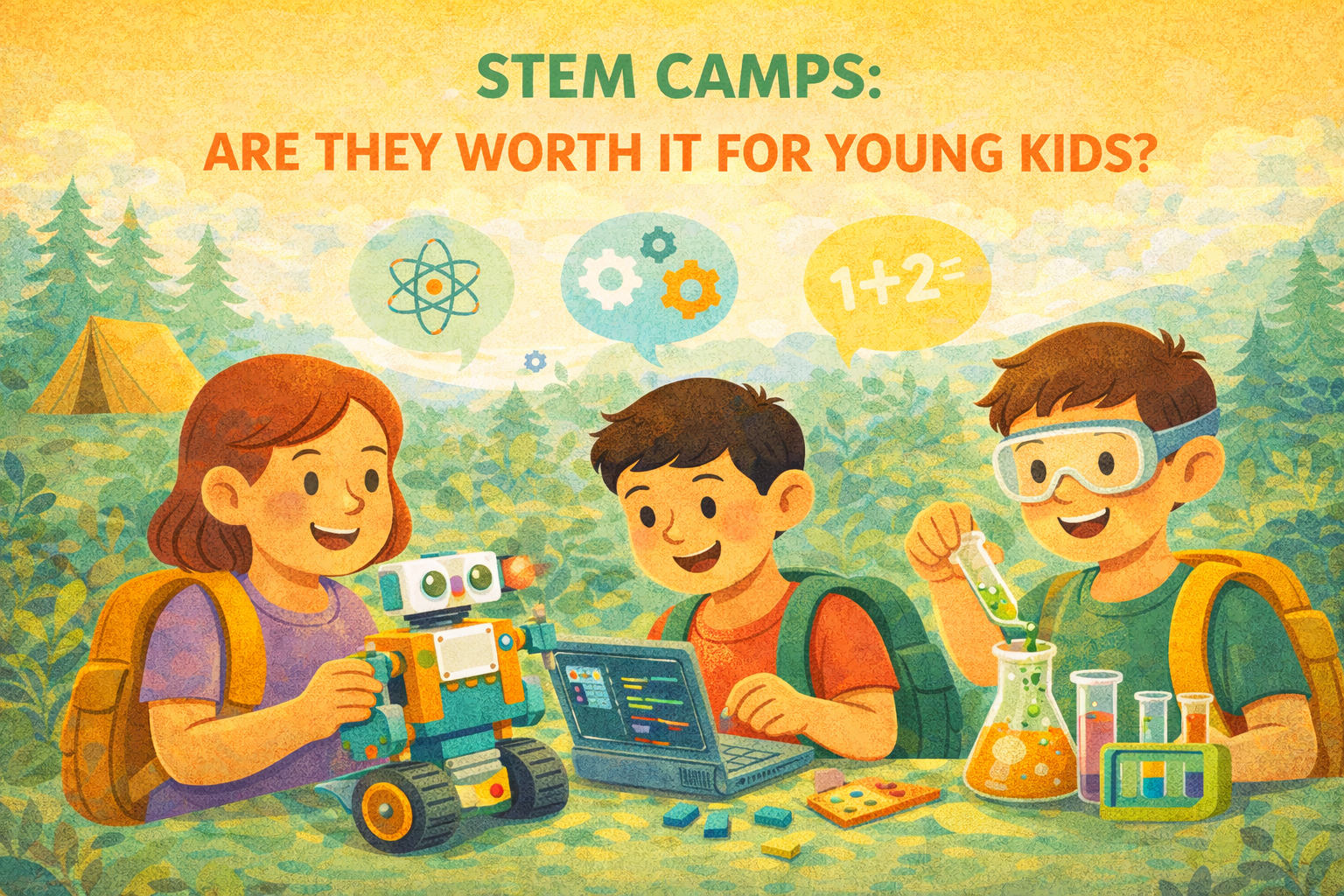
A friend shared this moment after picking up her six-year-old from a STEM camp. She expected stories about games or snacks. Instead, her child spent the entire car ride explaining sensors, gears, and trial-and-error experiments—with wide eyes and endless excitement.
That’s when she wondered, “Is this really worth it… or is it too much, too soon?”
As STEM camps become more common across Asia, many parents are asking the same thing: Are STEM camps worth it for young kids? Are they truly beneficial, or just another trend adding pressure too early?
Let’s take a closer look—honestly, thoughtfully, and without the hype.
What Are STEM Camps, Really?
STEM stands for Science, Technology, Engineering, and Mathematics. STEM camps are programs designed to introduce children to these subjects through hands-on, interactive activities.
For young kids, STEM camps usually focus on:
Building simple machines
Coding through games
Robotics with blocks or sensors
Science experiments
Problem-solving challenges
Importantly, good STEM camps don’t feel like school. They feel like play with purpose.
Parents often explore different STEM camp formats through platforms like Camp Finder Asia, which feature programs designed specifically for younger age groups:
👉 https://campfinderasia.com/
Why STEM Camps Are Growing So Quickly in Asia
Across Asia, STEM education has become a priority. Parents want to prepare children for a future shaped by technology, innovation, and problem-solving.
STEM camps are growing because they:
Introduce future-ready skills early
Encourage curiosity over memorization
Offer screen-time alternatives with learning value
Support creative thinking, not just academics
However, popularity alone doesn’t guarantee suitability—especially for young children.
Are Young Kids Ready for STEM Camps?
The short answer: yes—when the program is age-appropriate.
Young children are naturally curious. They love to:
Ask “why”
Take things apart
Build, test, and rebuild
Explore how the world works
STEM camps work well when they build on this curiosity instead of forcing formal learning.
What STEM Camps Get Right for Young Kids
1. Learning Through Play, Not Pressure
The best STEM camps feel like discovery zones.
Kids learn concepts without realizing they’re learning. They:
Experiment freely
Make mistakes without fear
Celebrate effort over results
This playful approach is key for younger children.
2. Developing Problem-Solving Skills Early
Rather than giving answers, STEM camps encourage kids to:
Try different solutions
Think critically
Adjust when something doesn’t work
These skills matter far beyond STEM—they support confidence and independence.
3. Building Confidence With “I Did It!” Moments
When a child builds something that works, even after multiple tries, confidence grows.
STEM camps create many of these moments:
A robot finally moves
A bridge holds weight
An experiment works
Confidence developed this way is powerful and long-lasting.
Common Concerns Parents Have (and Honest Answers)
“Isn’t STEM too academic for young kids?”
It can be—if poorly designed.
However, quality STEM camps focus on concepts, not content. They prioritize exploration, not exams.
“Will my child feel pressured or compared?”
Good camps avoid competition. They emphasize:
Collaboration
Personal progress
Teamwork
Children work together rather than being ranked.
“What if my child isn’t interested in science or tech?”
STEM camps don’t require prior interest. Many kids discover new passions simply by trying.
Often, children who think they “don’t like science” enjoy STEM camps because they’re hands-on and creative.
What Skills Do Young Kids Gain From STEM Camps?
Beyond academics, STEM camps help develop:
Curiosity and creativity
Logical thinking
Patience and persistence
Collaboration and communication
Confidence in trying new things
These are foundational life skills, not just technical ones.
STEM Camps vs Traditional Enrichment Classes
Traditional Classes Often Focus On:
Worksheets
Memorization
Sitting still
Right or wrong answers
STEM Camps Focus On:
Exploration
Movement and interaction
Open-ended challenges
Learning through doing
For young kids, this difference matters greatly.
Day STEM Camps vs Short-Term Programs
For younger children, shorter programs are often better.
Day STEM Camps
Ideal for first-time campers
Allow kids to return home daily
Offer structure without overwhelm
These are often recommended starting points and can be explored via Camp Finder Asia:
👉 https://campfinderasia.com/
What Age Is Best to Start STEM Camps?
There’s no single answer, but general guidelines help.
Ages 4–5: Gentle STEM play, storytelling, simple building
Ages 6–7: Introductory robotics, coding games, experiments
Ages 8+: More structured projects and challenges
Readiness matters more than age.
Signs a STEM Camp Is Right for Your Child
Your child may benefit if they:
Enjoy building or creating
Ask lots of “how” questions
Like solving puzzles
Show curiosity about how things work
Even shy or non-technical kids often thrive when activities are hands-on and social.
What to Look for in a Quality STEM Camp
Before enrolling, ask:
Is the program age-appropriate?
Are activities hands-on and playful?
Are instructors trained to work with young kids?
Is collaboration encouraged?
Are mistakes treated as learning opportunities?
Clear answers indicate a thoughtful, child-centered program.
How Camp Finder Asia Helps Parents Choose the Right STEM Camp
With many options available, comparison is key.
Camp Finder Asia helps parents:
Discover STEM camps across Asia
Compare programs by age and focus
Understand camp structure and learning style
Choose options aligned with their child’s readiness
Explore STEM camp options here:
👉 https://campfinderasia.com/
A Real-Life Story – From “I Can’t” to “Watch This!”
Ella, age six, once avoided puzzles because she was afraid of getting them wrong. Her parents enrolled her in a short STEM camp focused on building and experimenting.
On day one, she hesitated. By day three, she proudly explained how her structure worked—and why her first attempt failed.
Her parents noticed a shift. Ella wasn’t just learning STEM concepts. She was learning confidence through persistence.
When STEM Camps Might Not Be the Best Fit (Yet)
STEM camps may not be ideal if a child:
Struggles with group settings
Becomes overwhelmed by structured activities
Needs more free play first
In these cases, waiting or choosing a more general camp is perfectly okay.
Balancing STEM With Other Experiences
STEM camps don’t need to replace everything else.
Many families balance:
Creative camps
Sports or outdoor camps
STEM programs
This well-rounded approach supports holistic development.
FAQs About STEM Camps for Young Kids
1. Are STEM camps only for “smart” kids?
No. STEM camps are for curious kids, not just academically advanced ones.
2. Will STEM camps help with school performance?
They support thinking skills and confidence, which often translate to better learning.
3. Are screens heavily used?
Many STEM camps use minimal screens and focus on physical interaction.
4. How long should a first STEM camp be?
Short programs (3–5 days) are ideal for young children.
5. Are STEM camps expensive?
Costs vary widely. Value depends on quality, not price alone.
6. Where can I explore STEM camps in Asia?
Parents often use Camp Finder Asia to compare programs:
👉 https://campfinderasia.com/
Conclusion – So, Are STEM Camps Worth It for Young Kids?
When thoughtfully designed, STEM camps are absolutely worth it for young kids.
They don’t push children into academics too early. Instead, they nurture curiosity, confidence, and problem-solving through play and exploration.
The key is choosing the right program—one that respects childhood, encourages discovery, and meets children where they are.
When that balance is right, STEM camps don’t just teach kids how things work—they teach them to believe they can figure things out.
Explore age-appropriate STEM camps across Asia at:
👉 https://campfinderasia.com/