
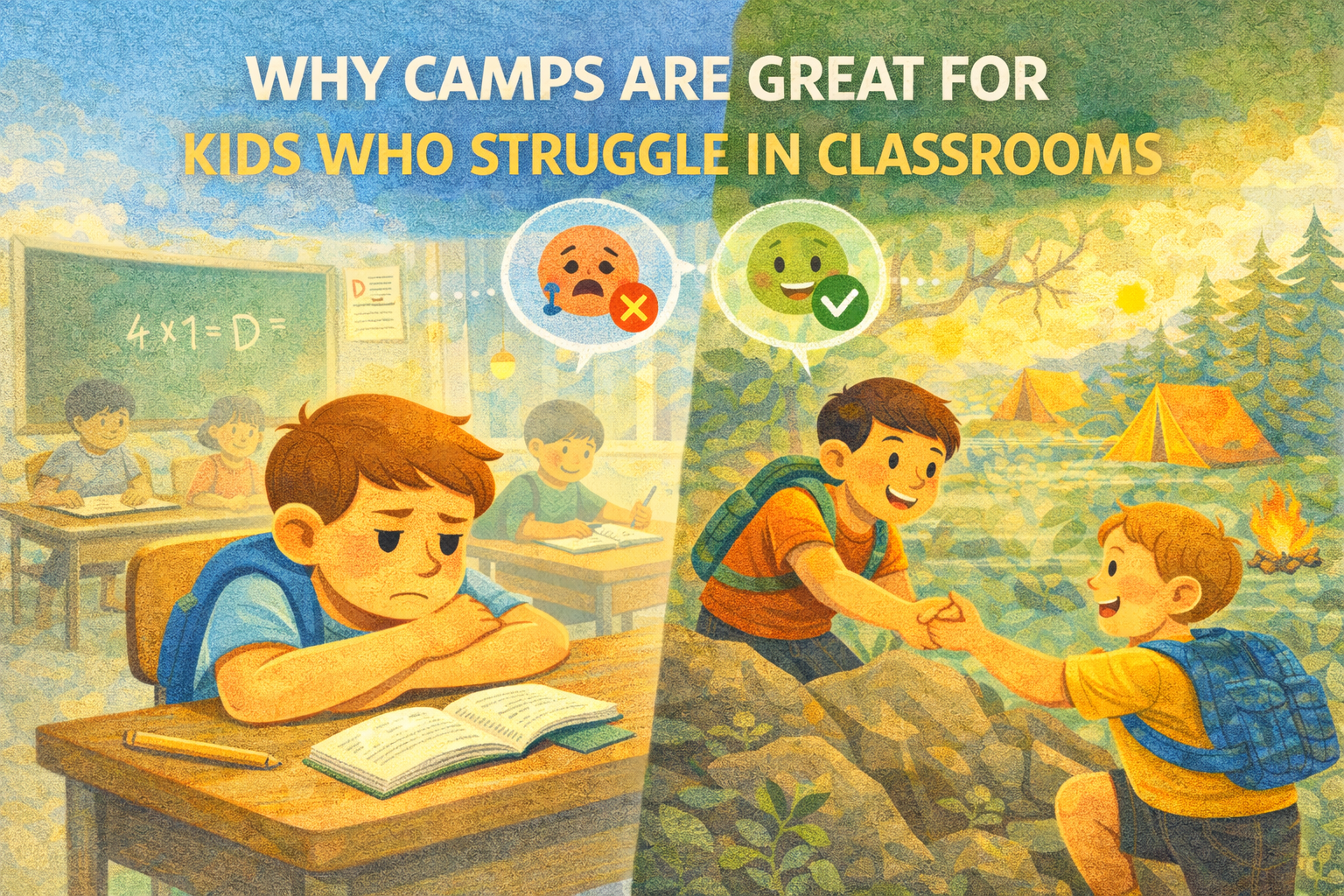
Introduction – When School Feels Harder Than It Should
Every parent knows the feeling.
You sit at the dining table helping with homework, and instead of confidence, you see frustration. Your child isn’t “bad at school,” but classrooms just don’t seem to work for them. They’re bright, curious, and capable—yet lessons feel overwhelming, and motivation slips away.
A parent once put it simply:
“My child isn’t failing. School just doesn’t see how they shine.”
For many children, traditional classrooms aren’t the best place to learn. And that’s okay.
This is where camps can be life-changing.
In this article, we’ll explore why camps are great for kids who struggle in classrooms, how camp environments support different learning styles, and why many parents see camps as places where their children finally feel capable, confident, and understood.
Why Some Kids Struggle in Traditional Classrooms
Before we talk about camps, it’s important to understand why classrooms can be challenging for some children.
Classrooms often require children to:
Sit still for long periods
Learn at a fixed pace
Absorb information verbally or through reading
Be assessed through tests and worksheets
For many kids, this works well. For others, it doesn’t reflect how they learn best.
Children may struggle in classrooms if they are:
Highly active or kinesthetic learners
Creative thinkers who dislike rigid structures
Slower processors who need more time
Sensitive to noise or pressure
Anxious about tests or comparison
These challenges don’t mean a child lacks ability. They often mean the environment isn’t the right fit.
Why Camps Offer a Completely Different Learning Experience
Camps are intentionally designed to be different from classrooms.
At camp:
Learning is hands-on
Movement is encouraged
Success isn’t measured by grades
Collaboration replaces competition
This shift alone can unlock confidence in children who struggle academically.
Parents across Asia often explore these alternative learning environments using Camp Finder Asia, which showcases a wide range of camps designed to support different strengths and personalities:
👉 https://campfinderasia.com/
1. Camps Value Strengths Beyond Academics
In classrooms, success is often narrowly defined.
At camp, success looks different.
Children are valued for:
Creativity
Leadership
Problem-solving
Teamwork
Empathy
A child who struggles with writing may excel at building, organizing, or encouraging others. Camps recognize and celebrate these strengths.
2. Learning Happens Through Doing, Not Sitting
Many kids learn best by moving and experimenting.
Camps use:
Hands-on activities
Games and challenges
Real-world problem-solving
Physical engagement
This approach helps children understand concepts intuitively—without the pressure of “getting the right answer.”
3. Reduced Pressure Leads to Better Learning
Pressure shuts learning down.
At camp:
There are no exams
Mistakes are normal
Effort is celebrated
Children who feel anxious in classrooms often relax at camp, allowing curiosity and motivation to return.
4. Confidence Grows Through Small Wins
Kids who struggle in school often hear what they’re doing wrong.
Camps focus on what’s going right.
Small wins—completing a challenge, helping a friend, trying something new—add up. Over time, children begin to believe in themselves again.
5. Social Skills Improve Naturally
Some children struggle socially in classrooms due to:
Large class sizes
Limited interaction time
Structured seating
Camps encourage:
Team activities
Open conversation
Cooperative problem-solving
These environments help children practice social skills without the pressure of formal settings.
6. Movement Supports Focus and Emotional Regulation
Lorem ipsum doloa
For active children, sitting still all day is exhausting.
Camps allow:
Frequent movement
Outdoor play
Physical challenges
This helps regulate energy levels and emotions, making it easier for children to stay engaged and calm.
r sit amet, consectetur adipiscing elit. Ut elit tellus, luctus nec ullamcorper mattis, pulvinar dapibus leo.
7. Emotional Safety Comes First
Children who struggle in school may feel embarrassed, behind, or discouraged.
Great camps prioritize emotional safety by:
Normalizing challenges
Offering encouragement
Avoiding comparison
When children feel safe emotionally, learning becomes possible again.
8. Different Learning Styles Are Respected
Camps naturally support:
Visual learners (through demonstrations)
Kinesthetic learners (through movement)
Social learners (through teamwork)
Creative learners (through open-ended activities)
This inclusivity helps children feel understood rather than “wrong.”
9. Teachers Become Mentors, Not Evaluators
Camp facilitators aren’t grading children.
They act as:
Guides
Coaches
Encouragers
This changes how children relate to adults in learning environments—often rebuilding trust that may have been strained in school.
10. Failure Is Reframed as Part of Growth
In classrooms, failure can feel final.
At camp, failure is expected.
Children learn to:
Try again
Adjust strategies
Ask for help
Persist
This resilience often carries back into school life.
Day Camps vs Overnight Camps for Struggling Learners
Day Camps
Gentle introduction
Ideal for younger or anxious children
Allow daily family reassurance
Overnight Camps
Build deeper independence
Strengthen confidence
Help children see themselves as capable
Parents can explore both options on Camp Finder Asia:
👉 https://campfinderasia.com/
A Real-Life Story – When Camp Changed Everything
Ethan dreaded school. Homework ended in tears, and he believed he “wasn’t smart.”
At camp, Ethan discovered he was excellent at problem-solving and helping others. For the first time, adults praised his thinking—not his test scores.
After camp, his parents noticed a shift. Ethan still found school challenging—but he no longer believed he was incapable.
That belief changed everything.
How Camps Complement School (Not Replace It)
Camps don’t replace education.
They support it by:
Restoring confidence
Improving motivation
Developing resilience
Strengthening social skills
Children who feel capable are more willing to engage in classroom learning.
How Camp Finder Asia Helps Parents Find the Right Fit
Not every camp suits every child—especially those who struggle in classrooms.
Camp Finder Asia helps parents:
Discover camps across Asia
Compare program styles and focus
Identify supportive, inclusive environments
Choose camps aligned with their child’s needs
Explore supportive camp options here:
👉 https://campfinderasia.com/
Common Parent Concerns About Camps for Struggling Learners
“What if my child struggles at camp too?”
Camps are designed to support growth—not test performance.
“Is my child too far behind?”
Camps don’t measure progress academically.
“Will camp undo school routines?”
Most children return to school more confident and motivated.
FAQs About Camps for Kids Who Struggle in Classrooms
1. Are camps suitable for children with learning differences?
Many camps are inclusive and supportive of diverse learners.
2. Do camps help with confidence?
Yes. Confidence is one of the most common benefits parents notice.
3. How long should a first camp be?
Short programs are often best for first-time campers.
4. Will camp help my child enjoy learning again?
Many children rediscover curiosity and joy through camp experiences.
5. Are camps only for extroverted kids?
No. Camps support all personality types.
6. Where can parents find supportive camps in Asia?
Parents often use Camp Finder Asia:
👉 https://campfinderasia.com/
Conclusion – When Learning Finally Feels Possible
Children who struggle in classrooms don’t need to be “fixed.”
They need environments that fit who they are.
Camps offer space to move, explore, fail safely, and succeed meaningfully. They help children rediscover confidence, capability, and curiosity—often for the first time in a long while.
For many families, camps aren’t just holiday activities. They’re places where children finally feel seen.
Explore camps that support diverse learners across Asia at:
👉 https://campfinderasia.com/